
California · DMV
Sharing the road in California
The vehicles that do not behave like yours, from trucks and buses to light rail, motorcycles and bicycles, and what California asks of you around each one.
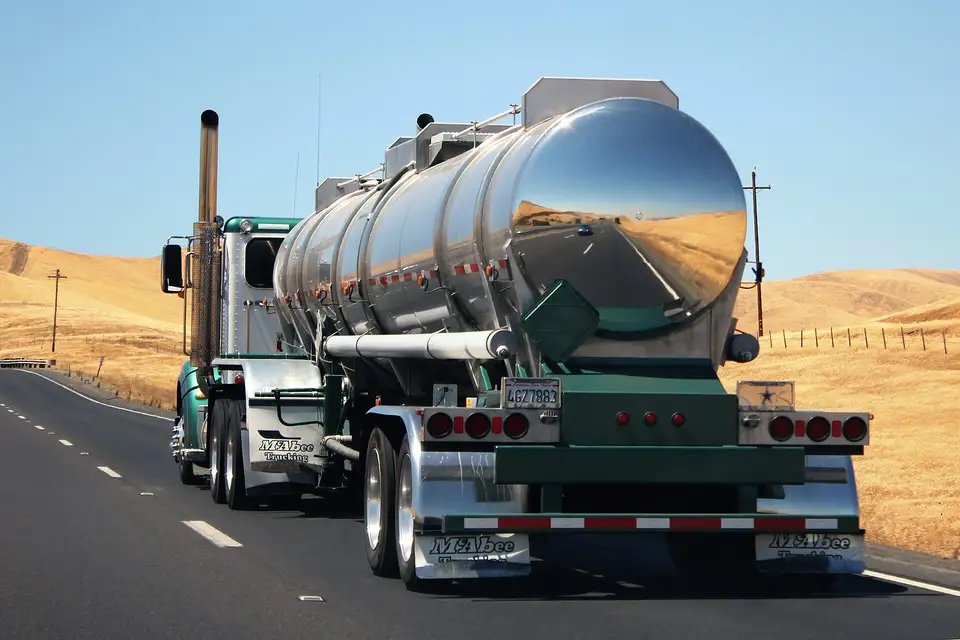
Large vehicles: where you disappear
A truck is not a big car. Almost every rule in this section comes from three physical facts that do not apply to you: the driver sits high with enormous mirrors and still cannot see the space beside the trailer, the mass takes much longer to stop, and the back wheels do not follow the front ones around a corner.
The useful version, the one worth carrying into the test and into traffic, is a question you can answer from your own seat: can you see the mirrors on the side of that truck? If not, you are in a place where the driver has no idea you exist, and the answer to almost anything the test asks next is to get out of it.
- The driver of a large vehicle sees further ahead than you and has much bigger mirrors, and still has wide blind spots, the No Zones, where your car simply is not there for them. p. 42
- The test for being in one: if the side mirrors of the truck are not visible to you, the driver cannot see you. p. 42
- From 55 mph an average car can be stopped inside 300 feet and a large vehicle may need as much as 400 feet, and a loaded truck needs more of it than an empty one. p. 42
- The gap a truck keeps ahead of itself is deliberate: it is the room the driver will need if something forces a sudden stop. p. 42
- Never move in front of a large vehicle and then slow down or stop. It cannot brake hard enough to avoid running into you. p. 43
- The rear wheels of a long vehicle track inside the front ones, and the longer the vehicle the bigger that difference, which is why trucks have to swing wide to get around a corner. p. 43
- Read the turn signals of a truck before you start to pass: one that looks like it is turning one way may be swinging wide to turn the other. p. 43
- On a divided highway with four or more lanes running one way, a large vehicle may use only the two lanes nearest the right. p. 43
- Pass a large vehicle on its left and then get ahead of it. Sitting alongside one leaves its driver nowhere to go when something appears in the road. p. 43
- Do not cut in front of a large vehicle to reach an exit or a turn, do not follow one closely, and do not assume it is slower than it looks. p. 43
Buses, streetcars and light rail
Two different things get confused here. A safety zone is a piece of road reserved for people on foot who are waiting to board, and it is absolute: you never drive across one. Passing the vehicle that is stopped there is allowed, but at a crawl, because the people who have just stepped off are about to walk into the space you are using.
Light rail is the other half. On the street a light rail vehicle is a vehicle like any other, with one rule of its own: you do not overtake it on its left, and the exceptions are narrow enough to memorize. Everything else about it is a visibility problem: the operator has blind spots created by buildings and trees, and the vehicle can hold the traffic lights for itself.
- A safety zone is the space set aside for people waiting to board a bus, a streetcar or a trolley, marked on the road with raised buttons or markers. You do not drive through one under any circumstances. p. 43
- A bus, streetcar or trolley stopped at a safety zone or at a light may be passed, but never faster than 10 mph. p. 43
- Do not overtake a light rail vehicle or a streetcar on its left, moving or standing, unless the tracks run so close to the right that you cannot pass on that side, you are on a one-way street, or a traffic officer sends you left. p. 44
- On a public road a light rail vehicle carries the same rights and the same duties as any other vehicle. p. 44
- Never turn in front of a light rail vehicle that is coming, and look for one before you turn across the tracks: complete the turn only when the traffic light tells you that you may. p. 44
- Buildings, trees and other obstacles create blind spots for the operator as well, so keep a safe distance, and remember that these vehicles can interrupt the traffic lights. p. 44
Motorcycles
A motorcycle is legally a vehicle with a normal claim to its lane, and practically an object small enough to vanish in the places you do not check. That combination is what the questions are built on: the correct answer almost always involves looking again, or leaving more room than a car would need.
Lane splitting is where people guess wrong, because it feels like something that should be prohibited. In California it is not, and knowing that is the whole question.
- A motorcyclist has the same rights and the same duties on the road as anybody driving a car. p. 44
- Look for motorcycles and use your mirrors before you change lanes or pull onto a road: a motorcycle is small enough to disappear into a blind spot. p. 44
- Leave a three-second following distance behind a motorcycle. That is the space that saves you if it brakes suddenly or goes down. p. 44
- Sharing a lane with a motorcycle, which is what lane splitting means, is legal in California. Even so, give a motorcycle the whole lane whenever you can. p. 44
- Never try to overtake a motorcycle inside your own lane, and where you can, move to one side of the lane to leave room for one to pass you. p. 44
- Check for a motorcyclist before you open a door next to traffic, and expect one to change speed or direction suddenly because of the surface of the road. p. 44
Bicycles
The questions about bicycles mostly test whether you know what a bicyclist is allowed to do, because a driver who thinks a cyclist is doing something illegal reacts badly to it. Riding out from the curb to get around a parked car, taking the lane where it is too narrow to share, moving left to prepare a turn: all of that is the cyclist following the rules, not breaking them.
On your side there is one measurement to know and one timing rule, and both exist for the same reason: a bicyclist forced toward parked cars or squeezed by a turning vehicle has nowhere to go.
- A bicyclist has the same rights and the same responsibilities as the driver of a vehicle. p. 46
- A bicyclist may move left to get clear of a hazard, and a hazard includes parked or moving vehicles, other bicycles, animals and trash in the road. p. 46
- On a one-way street a bicyclist may keep to the left curb instead, and may also use a crosswalk by stopping and crossing on foot. p. 46
- On certain stretches of freeway, where there is no alternative route and no law against it, a bicyclist may legally ride. p. 46
- A bicyclist going slower than the traffic has to stay as near the right curb as possible, and the exceptions are passing, getting ready to turn left, and avoiding a hazard or a bad piece of road. p. 47
- The other exceptions: a lane too narrow for a bicycle and a vehicle side by side, an approaching right turn, and a one-way road with two or more lanes, where the left edge is allowed. p. 48
- Where you cannot change lanes to pass a bicyclist, leave at least three feet of clearance. If you cannot give three feet, do not pass until you can. p. 48
- Do not enter a bike lane earlier than 200 feet before your turn, and merge in behind a bicyclist rather than across one. p. 48
- Leave a bicyclist enough space that they are not pushed into parked vehicles or an opening door, and move toward the curb or the bike lane only when it is safe. p. 48
- At night a bicycle needs a white front lamp visible from 300 feet, a red rear reflector or red light visible from 500 feet, and reflectors on the pedals, shoes or ankles visible from 200 feet. p. 47
Work zones
A work zone is the one place where the road you are reading is not the road that exists: the lanes have moved, the surface changes, and the people beside you are on foot. The behavior the handbook asks for is all deceleration and space, and the penalties are the part that surprises people.
- Signs and message boards warn you before a work zone. Go through it slowly, leave extra space, expect traffic to stop suddenly, watch for drivers changing lanes and put your distractions away. p. 49
- Cones, drums and barriers mark your path. Merge as soon as it is safe, without crossing them, and follow a flagger or any special instruction from a worker. p. 49
- Watch for bicycles inside a work zone, especially where the lanes are narrow or the shoulder is closed. p. 49
- A traffic violation in a work zone can cost $1,000 or more, and a conviction for assaulting a highway worker can mean a fine of up to $2,000 and as much as one year in prison. p. 49
- Some roads are designated Safety Enhanced-Double Fine Zones because of the injuries and deaths on them, and fines there are doubled. Fines also double in a construction or maintenance zone whenever workers are present. p. 49
- You have to move over and slow down for a stationary emergency vehicle or tow truck showing flashing amber lights, and for a stopped road work vehicle showing flashing or amber warning lights. p. 49
Slow vehicles, animals and big loads
What is left is the traffic that cannot keep up with you, and the traffic that is wider or heavier than it looks. Neither is a special case in the law (you adjust your speed and you wait), but each one has a marking or a number attached to it, and that is what gets asked.
- An orange and red triangle on the back of a vehicle marks it as slow moving. Road maintenance vehicles carrying one usually travel at 25 mph or less. p. 45
- Large trucks, bicycles and some cars lose speed on a long or steep hill, and anything slow takes longer to get up to speed when it joins traffic. p. 45
- Scooters, golf carts and neighborhood electric vehicles are also entitled to be on public roads, and your part is to adjust your speed around them. p. 46
- Neighborhood electric vehicles and low-speed vehicles reach 25 mph at most, and they are kept off roads where the posted limit is over 35 mph. Watch for NEV USE ONLY and NEV ROUTE signs. p. 46
- Horse-drawn vehicles and people riding horses or other animals may share the road with you, and frightening horses or livestock on purpose is against the law. p. 46
- Where a sign shows an animal, or livestock is near the road, slow down or stop, carry on when it is safe, and follow whoever is in charge of the animals. p. 46
- A diamond-shaped placard on a truck says the load may be dangerous, and a vehicle displaying one has to stop before it crosses railroad tracks. p. 50
- Towing a vehicle or a trailer, or driving a truck with three or more axles, keep to the far-right lane or a lane marked for slower traffic. Where nothing is marked and there are four or more lanes your way, you may use only the two nearest the right edge. p. 50
Why this matters: California by the numbers
- Passing a school bus with its red lights flashing: $691 and 1 DMV point. The full cost of a ticket
Now practice it
24 questions on sharing the road in the California question bank, each on its own page with the answer and the explanation, or take the full practice test.
Sources
- California Driver's Handbook, Sharing the Road
- California Driver's Handbook, Section 7: Laws and Rules of the Road
How we write and check this material: our methodology.