
California · DMV
Turns, lanes, passing and parking in California
Mostly distances and sequences: which lane a turn starts and ends in, when a U-turn is legal, how much room a pass needs, and where you may not park.
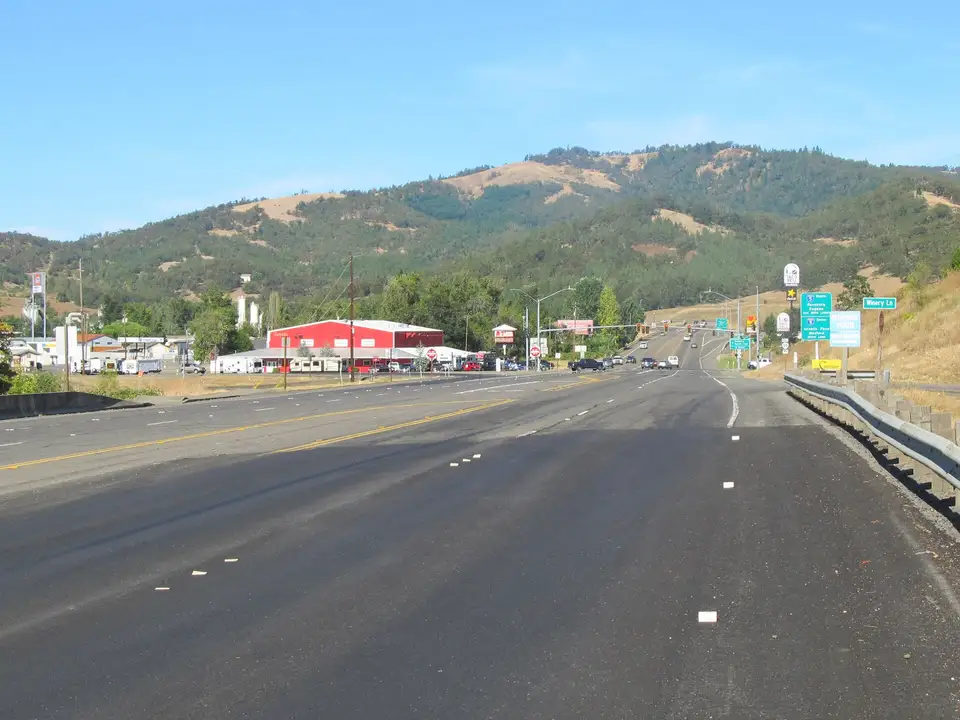
Choosing a lane, and changing one
Lanes are numbered from the left, which is worth knowing because signs and instructions use those numbers without explaining them. The rest of this is a sequence, and the test asks about the order of it: the mirror check is not a substitute for looking over your shoulder, because the thing you are looking for is in the place the mirror does not show.
One instruction here surprises people because it runs against the instinct: you do not slow down to change lanes. Braking in the middle of a lane change is how you end up with a car arriving behind you at the moment you are between lanes.
- Lanes get numbered from the left: the fast lane is the Number 1 Lane, the one to its right the Number 2 Lane, and so on. p. 15
- Use the left lane to pass or to turn left, and the right lane to join traffic, to leave it, or to pull out from a curb or a shoulder. p. 15
- Before you change lanes: signal, check the mirrors, check the traffic behind and beside you, look over your shoulder toward where you are going, and check the blind spots for cars, motorcycles and bicycles. p. 15
- Make sure the space in the next lane is big enough for your vehicle. You do not have to slow down to change lanes. p. 15
- Hold one lane as much as you can and do not weave through traffic: a last-second change of lane or of direction is what raises the risk of a crash. p. 15
- Once you are moving through an intersection, keep going, and if you have begun a turn, finish it. A missed turn is fixed further on, where turning around is safe and legal. p. 15
The lanes with rules of their own
Four lanes on a California road are not ordinary lanes, and each one has a condition attached: who may be in it, or how long you may stay. Two of them carry a distance, and distances are what multiple choice is built out of.
The bike lane is the one that catches drivers who believe they are being careful. Driving along it is illegal, yet entering it to turn is exactly what you are supposed to do, inside the last stretch before the intersection and after checking that nobody is already there.
- On a multilane road the passing lane is the far-left one, next to the center divider, and it is there for passing. p. 15
- A carpool or HOV lane is reserved for carpools, buses and motorcycles. The surface is marked with a diamond and the words Carpool Lane, and the signs give the minimum number of people and the hours the rule applies. p. 16
- Do not cross double solid lines to get into or out of an HOV lane: use the openings provided for it. p. 16
- A center left turn lane sits in the middle of a two-way street, bounded by a broken inner line and a solid outer one. It is for preparing and making a left turn or a U-turn, and it is neither a traffic lane nor a passing lane. p. 16
- You may travel no more than 200 feet inside a center left turn lane, and you merge completely into it so you do not block traffic. p. 16
- On a two-lane road where passing is unsafe, you have to use a turnout area or lane to let others by once five or more vehicles are following you. p. 16
- Driving in a bicycle lane is illegal except to park where that is allowed, to enter or leave the road, or to turn, and then only within 200 feet of the intersection. p. 17
Right turns and left turns
Every turn in the handbook has the same shape: position, signal, look, stop where the law says to stop, then turn and end up in the lane the rule names. The lane you finish in is the half people forget, and it is the half that gets asked, because a turn that swings wide into the next lane is how two vehicles end up in one place.
The left turn adds one piece of advice that sounds like trivia and is not: keep the front wheels straight while you wait. If they are already pointed left and somebody hits you from behind, the car you are sitting in is aimed at oncoming traffic.
- For a right turn, get close to the right edge of the road, or enter a dedicated right turn lane at its opening, and start signaling about 100 feet before the turn. p. 18
- You may use a bike lane within 200 feet of a right turn. Check your blind spots for bicyclists first, and watch for anybody on foot, on a bike or on a motorcycle between your car and the curb. p. 18
- Stop behind the limit line, the wide white line that marks where to stop. Where there is none, stop before the crosswalk; where there is no crosswalk either, stop before entering the intersection. p. 18
- Finish a right turn in the lane nearest the right edge. Do not swing wide into another lane. p. 18
- A right turn on red is allowed after a full stop unless a NO TURN ON RED sign is posted; at a red arrow it is not allowed at all, and you wait for green. p. 18
- Driving, stopping or parking in a lane marked for public transit buses is illegal, though crossing one is allowed when the point of it is to turn right. p. 18
- A dedicated right turn lane that does not merge into another lane lets you turn without stopping, even when the light for traffic going straight is red, unless there is a light or a sign on the right curb of that lane, which you obey instead. You always yield to people in the crosswalk. p. 19
- A left turn starts from beside the center divider, or from the left turn lane, entered at its opening and never across a solid line. A two-way center left turn lane may be entered inside the last 200 feet before the turn. p. 19
- Signal 100 feet before a left turn, look over your left shoulder, slow down, and stop at the limit line, the crosswalk or the intersection, in that order of preference. p. 19
- Leave the wheels pointed straight until the moment you can go: pointed left, a hit from behind pushes you into oncoming traffic. p. 19
- Turning left from a two-way street, start from the left lane nearest the middle of the road and finish in the equivalent lane of the street you are entering. p. 21
- Turning left onto a one-way street with three or more lanes going your way, you may finish the turn in any lane that is open. p. 21
- You may turn left against a red light only from a one-way street onto a one-way street, with no sign forbidding it, giving way to everyone who has the green. p. 20
U-turns: four places yes, seven places no
The U-turn is the single most list-like rule in the handbook, and there is no logic that will get you to the answer: it has to be learned. What helps is noticing that the prohibitions are all about sight lines and about places where somebody needs the road clear: a fire station, a railroad crossing, a business district full of people stepping off the curb.
- A U-turn is turning your vehicle around to go back the way you came. Signal and use the left turn lane or the far-left lane. p. 20
- A double yellow line is no obstacle to a U-turn. Nor is an intersection on a green light or a green arrow, unless a NO U-TURN sign is posted, nor a divided highway where the center divider has an opening in it. p. 20
- In a residential district you may make a U-turn when no vehicle is coming toward you within 200 feet. p. 20
- A posted NO U-TURN sign settles it. So does a railroad crossing, before one or on one, and so does a one-way street. p. 20
- Never make one on a divided highway by crossing the dividing section, a curb, a strip of land or two sets of double yellow lines. p. 20
- Never make one where your view falls short of 200 feet either way, and never in front of a fire station, whose driveway is also not a place to turn around. p. 20
- In a business district a U-turn is out, and the only ways back in are an intersection or a divided highway with an opening in the divider. p. 20
Joining traffic, leaving it, and passing
Merging and passing are the same skill measured twice: judging a gap you are going to occupy. The handbook puts numbers on gaps, which is unusual and therefore testable: a gap in the city is about half a block and one on the highway about a full one, and both come with a length in feet.
On passing, notice which rule is a prohibition and which is a technique. Not passing near a hill, a curve, an intersection or a crossing is law. Passing on the right is the narrow exception, not a choice you get to make because the left lane is busy.
- Traffic already on the highway has the right of way. Come down the on-ramp in the proper lane, at or near the speed of that traffic, and merge into a space big enough for your vehicle without stopping unless you have no choice. p. 23
- Leave three seconds of space to the vehicle in front so you can stop safely, and turn your head to look over your shoulder before you merge. p. 23
- Do not cross solid lines to merge. Several lanes to cross means one at a time, signaling and checking the blind spots each time. p. 23
- To leave a highway, signal five seconds before the exit, which is about 400 feet, from the proper lane, and do not cross solid lines on the way out. p. 23
- Entering traffic from a stop needs a gap of about half a block in the city, some 150 feet, and about a full block on the highway, some 300 feet. p. 24
- Turning left, do not trust an oncoming right turn signal: the driver may have left it on by mistake or may be turning past you. Wait until the vehicle begins its turn. p. 24
- To pass safely near a hill or a curve, it should be at least one-third of a mile ahead of you, and never pass when you cannot see whether traffic is coming. p. 24
- Do not pass within 100 feet of an intersection, a bridge, a tunnel, a railroad crossing or another hazardous place, and never at crossroads or driveways. p. 24
- Never start a pass without room to come back into your lane. p. 24
- Passing on the right is allowed only on an open highway with two or more lanes going your way, when the driver ahead is turning left and the right side is safe, or on a one-way street. Never pass on the left a driver who is signaling a left turn. p. 25
- Never drop a wheel off the pavement, or off the main-traveled part of the road, to get around somebody. And when somebody passes you, hold your lane and your speed and let them. p. 25
Parking, curb colors and where you may not stop
Parallel parking is a set of measurements, and the DMV publishes all of them, so the questions are about the numbers rather than about the idea. The hill rule is where the reason does the remembering for you: the wheels are turned so that a car with failed brakes rolls into the curb or off the road instead of into traffic, which tells you the direction in every case, including the case with no curb at all.
Curb colors and the list of places you may not stop are the rest of the topic. They are pure recall, and the distances in them are what separates two plausible options.
- To parallel park, the space has to be at least three feet longer than the car itself. Signal, then pull up alongside the vehicle ahead of it, leaving about two feet between you. p. 26
- Stop with your rear bumper level with the front of the space, then back in at about a 45-degree angle, straightening the wheel away from the curb once your rear wheel is within 18 inches of it. You should end up parallel and within 18 inches of the curb. p. 26
- Then set the parking brake, and look for passing cars, bicycles and motorcycles before you open the door. p. 26
- Backing in a straight line, the exercise asks for three vehicle lengths while staying within three feet of the curb. p. 27
- Parked facing downhill, turn the front wheels into the curb or toward the side of the road. Facing uphill, turn them away from the curb and let the car roll back until the wheel touches it gently. p. 27
- With no curb, uphill or downhill, turn the wheels to the right so a car with failed brakes rolls away from the middle of the road. On a sloping driveway, point the wheels so it cannot roll into the street. Set the parking brake and leave it in park, or in gear with a manual. p. 27
- The curb colors: white is long enough to pick up or drop off passengers, green is limited time as posted, yellow is loading passengers or freight for no longer than posted, red is no stopping at all, and blue is for a disabled person with a placard or plate. p. 28
- Never park on a crosswalk, marked or not, on a sidewalk or partly across one, in front of a driveway, or in the crosshatched area beside a disabled parking space. p. 28
- Keep three feet clear of a sidewalk ramp for disabled people, 15 feet clear of a fire hydrant or a fire station driveway, and 20 feet clear of a crosswalk, or 15 feet where a curb extension is present. p. 28
- No parking in a tunnel or on a bridge unless a sign allows it, no double parking, and nothing between a safety zone and the curb. p. 28
- Stopping or parking on a freeway, or facing the wrong way on a street, is illegal except in an emergency, when an officer requires it, or where it is specifically permitted. If you must stop on a freeway, get completely off the pavement and stay inside with the doors locked; after four hours the vehicle can be towed. p. 29
Why this matters: California by the numbers
- Unsafe turn or lane change was the primary cause of 86,183 California crashes in 2024. What causes crashes
- Straddling or weaving between lanes was the primary cause of 31,035 California crashes in 2024. What causes crashes
- Unsafe turn or lane change: $234 and 1 DMV point. The full cost of a ticket
Now practice it
27 questions on turns, lanes, passing and parking in the California question bank, each on its own page with the answer and the explanation, or take the full practice test.
Sources
How we write and check this material: our methodology.