
California · DMV
California speed limits and the basic speed law
The limits that apply when no sign tells you otherwise, the rule that overrides every one of them, and why being slower than the traffic around you can also be a citation.
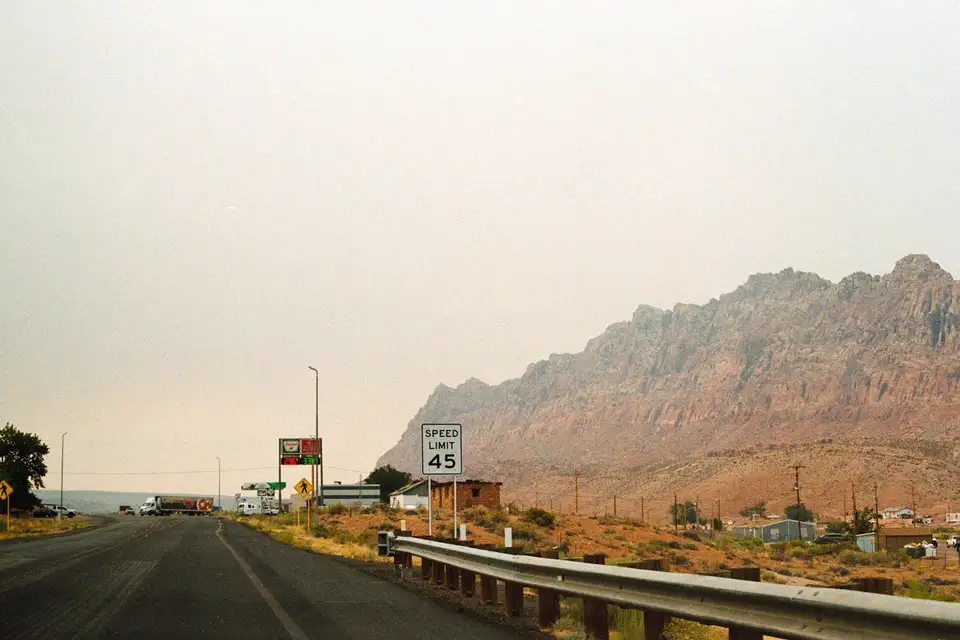
The rule that beats the sign
California starts from a principle rather than a number: whatever the sign says, you may not drive faster than is safe for the road as it is right now. A posted limit is a ceiling for good conditions, not a speed you are entitled to.
This is the most commonly missed idea in the topic, because it is the one question where looking for a number is the wrong instinct. In fog, in traffic, on gravel, with a cyclist ahead, the legal speed is lower than the sign and the sign has not changed.
- The basic speed law: in California you may never go faster than is safe for the conditions of the road at that moment. p. 67
- Whatever is posted, your speed should follow how many vehicles are around you and how fast they are going, the surface under you, whether there are people walking or cycling on or across the road, the weather, and how congested the traffic is. p. 67
- Where nothing is posted, the ideal maximum on most California highways is 65 mph. It drops to 55 mph on a two-lane highway with no divider, and for anything towing a trailer. p. 67
The limits when no sign tells you
These are the numbers worth learning cold, because the question will describe a place rather than show you a sign: a road between buildings, an alley behind them, a corner with no stop signs on any side. Each description has a limit attached to it.
They come in two values, which makes them easier than they look. Somewhere you cannot see what is coming, it is the lower one; somewhere people live, work or walk, it is the higher one.
- In a business or residential district the limit is 25 mph unless a sign says otherwise. p. 52
- Near a school the limit is 25 mph within 500 feet of it while children are outside or crossing the street, and some school zones post limits as low as 15 mph. p. 50
- At a blind intersection the limit is 15 mph. An intersection counts as blind when no corner has a stop sign; if something blocks your view, edge forward until you can see. p. 51
- In an alley the limit is 15 mph. An alley is a road no more than 25 feet wide that serves the back or the side of buildings. p. 51
- Within 100 feet of a railroad crossing the limit is 15 mph when you cannot see 400 feet down the track in both directions. You may go faster than that where gates, a warning signal or a flagman control the crossing. p. 51
Too slow is also a violation
Speed questions are not only about going fast. California requires you to slow down for traffic and weather, and separately forbids you from holding up the traffic that is moving normally. Both of those can be cited.
The resolution is about position, not speed: if you are going slower than everyone else, the right lane is where you belong, and someone sitting behind you wanting past is a reason to move right rather than to speed up.
- You have to drive more slowly when traffic is heavy or the weather is bad, and at the same time you must not hold up the normal, reasonable flow by crawling. p. 50
- You can be cited for driving faster than the limit and for driving slower than it. p. 50
- When a driver behind you is close and wants to go faster, move to the right. If you choose to travel slower than the rest of the traffic, stay in the right lane. p. 50
School zones and school buses
A school zone is the one place where the speed rules and the right-of-way rules are usually tested in the same question, because what governs your speed there is often a bus rather than a sign.
The distinction to hold on to is between the two colors of flashing light on a bus, and the one exception that lets you keep going. Yellow is a warning that the stop is coming. Red is a stop for everyone, in both directions, unless a divided or multilane highway separates you from the bus.
- Around a school, watch for people on bikes and on foot, for safety patrols and crossing guards whose directions you must always follow, and for stopped buses with children crossing. p. 50
- Yellow flashing lights on a school bus mean it is about to stop to let children off: slow down and get ready to stop. p. 50
- When the red lights on a bus are flashing, traffic from both directions must stop and stay stopped until the children are safely across and the lights go off. p. 51
- Failing to stop for those red lights can bring a fine of up to $1,000 and a one-year suspension of your driving privilege. p. 51
- You do not have to stop when the bus is on the far side of a divided or multilane highway, meaning two or more lanes in each direction. p. 51
Why this matters: California by the numbers
- Unsafe speed for conditions was the primary cause of 118,505 California crashes in 2024. What causes crashes
- Speeding 1 to 15 mph over the limit (basic speed law): $234 and 1 DMV point; driving over 100 mph: $896. The full cost of a ticket
Now practice it
18 questions on speed limits in the California question bank, each on its own page with the answer and the explanation, or take the full practice test.
Sources
- California Driver's Handbook, Section 7: Laws and Rules of the Road
- California Driver's Handbook, Section 8: Safe Driving
How we write and check this material: our methodology.