
California · DMV
Safe driving and emergencies in California
How much room to leave, how much to slow down for rain, snow and ice, what to do in a skid, and the steps for a blowout, a breakdown or a stall on the tracks.
The space around you
Everything in this section is one idea measured in different directions: you need space, and space is time. The handbook gives you two numbers for it, one for how far ahead you should be looking and one for how far behind the vehicle in front you should be sitting, and they are both about having a moment to act rather than react.
Blind spots get their own list because the mistake is subtle. Checking them is not a glance at the mirror (the mirror is precisely where they are not), and it is not a swivel of the whole body either, which takes your hands with it. It is a turn of the head, and the handbook names eight moments when it is required.
- Your eyes should never settle: sweep 10 seconds ahead of where the car is, so that nothing arrives as a surprise. p. 57
- Use the three-second rule for following distance. Tailgating also hides the road: the vehicle ahead is blocking the view you need. p. 57
- When somebody merges in too close, lift your foot off the accelerator to open the gap again. p. 57
- With a tailgater behind you, hold your course and your speed, then merge right when it is safe and let them go by. p. 57
- Leave extra room behind a motorcycle on metal surfaces such as bridge gratings or railroad tracks, and on gravel. p. 57
- Do not sit in another driver’s blind spot or drive directly alongside another vehicle, and keep space between you and parked cars. p. 58
- Make room for vehicles coming onto a freeway even when the right of way is yours, and look both ways even where the other traffic has a red light or a stop sign. p. 58
- Your own blind spots sit at the sides, a little behind you. Check them by looking over each shoulder through the side window, turning only your head, not your body or the wheel. p. 58
- Check them before changing lanes, turning at an intersection, merging, backing up, leaving a parking space, parallel parking, pulling out from the curb and opening your door. p. 58
- Look behind you often, with the mirrors and by turning your head, when you change lanes, slow down, turn into a side road or driveway, pull into a space, pull up to or away from a curb, and back up. p. 59
Night, glare and fog
The rule that ties this together is one sentence: you have to be able to stop inside the distance you can see. Everything else follows from it: which beam, when to dim, when to give up and pull over. It is also why high beams are wrong in fog even though they are brighter.
The advice for oncoming headlights that are too bright is worth learning as written, because the instinct is to stare at them and the correct answer is to look at the right edge of your lane and keep the other vehicle in the corner of your eye.
- At night use the high beams on open country roads and dark streets, make sure you can stop within the distance they light, and dim them so you do not blind an oncoming driver. p. 59
- Faced with headlights that are too bright, do not look into them: look toward the right edge of your lane and watch the other vehicle out of the corner of your eye. Do not answer by leaving your own high beams on. p. 59
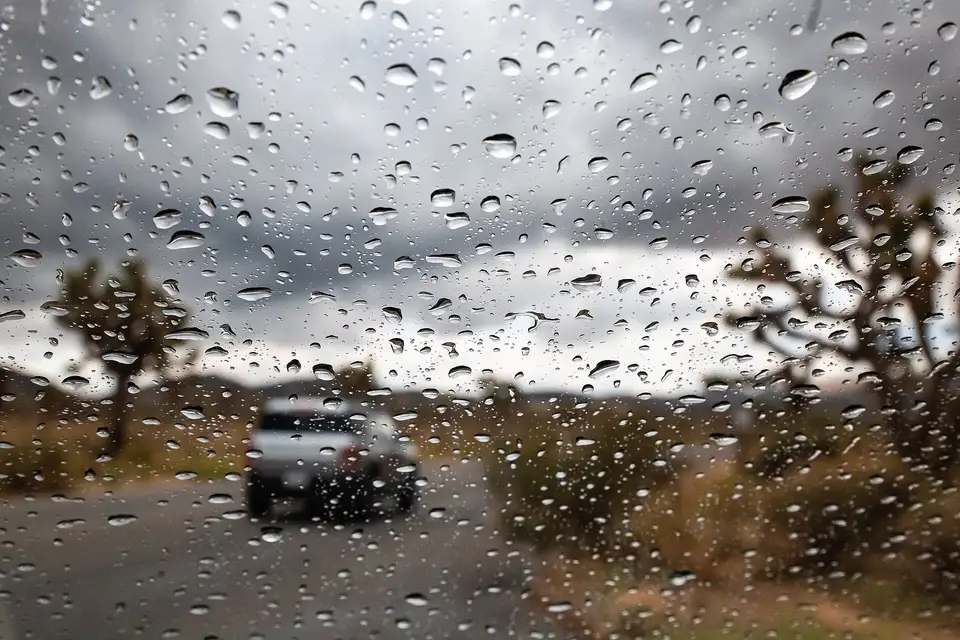
- In rain use the low beams, and never drive on parking lights alone. p. 59
- At night motorcycles, pedestrians and bicyclists are far harder to see, road work happens in the dark, and leaving a brightly lit place means driving slowly until your eyes adjust. p. 59
- A vehicle coming at you with one light gets as much room as you can give on the right: it may be a bicycle, a motorcycle or a car with a headlight out. p. 59
- For sun glare, keep both sides of the windshield clean, use polarized sunglasses, keep space around you, keep the visor usable, and watch for people on foot you may not see. p. 60
- In heavy fog or smoke, the first choice is not to drive. If you do, go slowly on low beams, never on parking or fog lights alone, and be able to stop inside what you can see. p. 64
- In fog, increase your following distance, avoid changing lanes or passing unless you must, listen for the traffic you cannot see, and pull off with the flashers on if it gets too thick. p. 64
- During a law enforcement traffic break, the officer weaves slowly across the lanes with the emergency lights on: put your flashers on, ease down to the same speed, keep back and do not pass the patrol vehicle. p. 64
How much to slow down for rain, snow and ice
This is the rarest kind of handbook rule: it turns judgment into arithmetic. There is a specific reduction for wet pavement, another for packed snow and a ceiling for ice, and because they are numbers, they are exactly what a written test can ask.
The other half is where the ice is when it is not obvious. Shade and bridges freeze before open pavement and dry last, and the most slippery moment of a rainstorm is the beginning of it, especially after a long dry spell, when the oil on the road has not been washed off yet.
- On wet pavement, take 5 to 10 mph off your speed. On packed snow, cut it in half. On ice, drive no faster than 5 mph. p. 61
- Shade from trees or buildings hides icy patches on cold wet days, and bridges and overpasses freeze before the rest of the road. p. 61
- The first drops are the moment to come off the speed, drizzle and snow included, and all the more after a long dry spell, when oil and dust are still on the surface. p. 61
- In a heavy rainstorm or snowstorm you may not see more than 100 feet ahead, and with that much visibility it is not safe to drive faster than 30 mph. p. 62
- Turn on the wipers, the low beams and the defroster, and stop when you need to in order to clear mud or snow off the windshield, the headlights and the taillights. p. 62
- If you drive in snow country, carry chains, in the right type and number for your vehicle. p. 62
- Crossing a flooded road is a last resort, because depth cannot be judged by looking and the dangers include being swept off the road, hidden debris, the road collapsing and fallen power lines. If there is no other route, go slowly and test the brakes afterward. p. 63
- In high winds, slow down, hold the wheel firmly, watch ahead for debris, turn cruise control off, and consider pulling over until it passes. Trucks, campers and anything towing a trailer are the most affected. p. 63
Skids, brakes and hydroplaning
A skid is a traction problem, so every correct answer here is about giving traction back rather than adding force. That is why the brake is the wrong instrument in most of these situations: braking is what asks the tire for grip it has already lost.
Steering into the skid is the counterintuitive half, and it sticks once you see why. The wheels are pointed where the car is going, which is the only way to line them up with the direction of travel and get them rolling again instead of dragging.
- A skid is one or more tires losing their grip on the road, and it becomes likely on ice or packed snow when you are going too fast or heading downhill. p. 60
- To avoid one, slow down before intersections and curves, avoid fast turns and quick stops, shift to a low gear before a steep descent, and stay off ice patches, wet leaves, oil and standing water. p. 60
- Once you are skidding: ease your foot off the accelerator, keep off the brakes, turn the wheel in the direction of the skid, and try to get a wheel onto dry pavement. p. 60
- Braking too hard at speed locks the wheels, and then the car slides whichever way the wheel is turned. With four-wheel ABS the answer is firm steady pressure on the pedal. p. 60
- With front-wheel ABS, come off the brake to unlock the wheels, steer where you want to go and straighten out as the car does. With no ABS at all, pump the brakes quickly until the speed is safe. p. 61
- If the pedal sinks to the floor, pump it gently. If pumping does not work, shift down or into neutral to lose speed and then use the emergency brake. p. 61
- Wet brakes can be dried by pressing the accelerator and the brake lightly at the same time, and only until they dry. p. 61
- Hydroplaning is the tires riding on water with no contact left, and then a small turn, a touch of brake or a gust of wind is enough to put you into a skid. p. 62
- To avoid it, drive slowly, steer around standing water, and slow down if you hear the tires sloshing or before you change lanes or direction. If it happens, slow gradually and stay off the brakes. p. 62
- Stuck in snow or mud, work the car free with a low gear, wheels straight and gentle throttle, rocking forward and back without spinning the wheels, and put boards or branches under the tires only with the vehicle stopped. p. 62
Seat belts, children and air bags
The reason a belt works is in the handbook and it is the sentence worth carrying: in a collision the car stops and you do not. You keep going at the speed you were traveling until something stops you, and the belt decides whether that something is the belt or the windshield.
The child restraint rules are a staircase of ages and sizes, and the questions come straight out of the thresholds. Note that each step has two ways to satisfy it, an age and a measurement, and that the rear-facing seat has a rule of its own about the front seat.
- You and your passengers have to wear seat belts, and it is a ticket if you do not. With a passenger under 16 who is unbelted, the ticket is yours as well. p. 65
- In a collision your vehicle stops and you keep moving at the speed you were traveling, until the dashboard or the windshield stops you. A struck side can throw you back and forth across the seat. p. 65
- Wear the shoulder harness across the shoulder and chest with almost no slack, never under the arm or behind the back, and keep the lap belt snug and low across the hips. p. 65
- Pregnant, the lap belt goes as low as possible under the abdomen, with the shoulder strap between the breasts and to the side of the bulge. p. 65
- Rear-facing is for the smallest: under 40 pounds, under 2 years old and below 3 feet 4 inches in height. A rear-facing restraint also may not go in the front seat of a vehicle with an airbag there. p. 66
- A child under 8 years old, or shorter than 4 feet 9 inches, rides in a child passenger restraint system in a rear seat, with a short list of exceptions such as no rear seat, side-facing or rear-facing rear seats, or all rear seats already taken by children 7 or younger. p. 66
- From 8 years old, or at least 4 feet 9 inches tall, a properly secured safety belt that meets federal standards is enough. p. 66
- Sit at least 10 inches from the airbag cover, measured from the middle of the steering wheel to your breastbone, and passengers should keep the same distance from theirs. p. 67
- Leaving a child of six years old or younger alone in a vehicle is illegal; someone at least 12 years old can supervise them. A parked car in the sun heats up fast even with a window open, and heat kills children and animals. p. 67
Emergencies
Three of these have an answer that feels wrong and is right: in a blowout you hold your speed instead of braking, off the pavement you brake gently instead of steering back hard, and stalled on a railroad track with a train coming you run toward the train, diagonally, because the wreck is going to be thrown along the tracks away from it.
The rest is procedure, and the number to remember is the one you call from the freeway.
- In a blowout, do not brake suddenly and do not snap your foot off the accelerator: hold the wheel with both hands, keep your speed if it is safe, release the accelerator gradually, steer to stabilize the car, and slow down and pull off once it is under control. p. 68
- With two hazards at once, deal with them one at a time and give the more dangerous one the room: let the oncoming vehicle go by first, then pull left to leave at least three feet passing the bicyclist. p. 68
- If your wheels drift off the pavement, grip the wheel, come off the accelerator, brake gently, check the traffic behind and steer back on carefully. A hard yank on the wheel is what sends you into oncoming traffic. p. 68
- In extreme heat, watch the temperature gauge, avoid long stretches at high speed and turn the air conditioning off. In extreme cold, watch the gauge too and use the defroster or crack a window to stop the glass fogging. p. 69
- Broken down on a freeway: pull onto the right shoulder, get out on the right side away from traffic if you have to get out, dial 511 or find a call box, and then stay in the vehicle with your seat belt on until help arrives. p. 69
- Getting out and away is safer when there is not enough shoulder, when there is a guardrail, or when there is somewhere clear of the lanes to wait. p. 69
- At commute times the CHP Freeway Service Patrol helps free of charge in some areas: a gallon of gas, a jump start, a radiator refill, a tire change, or a free tow to a CHP-approved location. p. 69
- The Freeway Service Patrol does not tow to a repair shop or a home, does not recommend tow companies, does not tow motorcycles and does not help a vehicle involved in a collision unless CHP tells it to. p. 70
- Stalled on a railroad track with a train coming and the lights flashing, get out at once and run away from the tracks diagonally, toward the side the train is coming from, then call 911. p. 70
- Stalled on a track with no train in sight, get out and call the number on the crossing post or the control box, give the crossing number, say there is a vehicle on the tracks, and then call 911. p. 70
Distraction, phones and one gas you cannot smell
The phone rules are the ones drivers think they already know, and the detail people miss is that for a minor there is no hands-free version: the exception is an emergency call and nothing else.
Carbon monoxide closes the section because it is the one hazard on this list that does not happen while you are driving.
- Common distractions are the phone, the navigation screen, children and pets, changing the music or the volume, and doing anything to your face. p. 70
- Driving with a handheld phone is illegal. Let a call go to voicemail, pull off the road if you have to make one, and do not read or write messages or email while driving. p. 70
- A phone may be mounted on the windshield, the dashboard or the center console, as long as it does not block your view, and you may use one swipe or touch on it. p. 71
- A minor may not use a phone or a wireless device at all while driving, to take a call or to answer a message. The one exception is a call for emergency help. p. 71
- Vehicles with advanced driver assistance systems may react to a situation differently than a person would, which is worth knowing before you rely on one. p. 71
- Every gas engine makes carbon monoxide, a deadly gas with no smell, so never start the engine in a closed garage. Tiredness, yawning, dizziness, nausea, headache and ringing ears are the warning signs, and they mean getting the exhaust checked. p. 71
Why this matters: California by the numbers
- Following too closely was the primary cause of 5,081 California crashes in 2024. What causes crashes
- Tailgating (following too closely): $234 and 1 DMV point; child not in a required car seat: $486. The full cost of a ticket
Now practice it
27 questions on safe driving and emergencies in the California question bank, each on its own page with the answer and the explanation, or take the full practice test.
Sources
- California Driver's Handbook, Section 8: Safe Driving
- California Driver's Handbook, Safe Driving (continued)
How we write and check this material: our methodology.